Integrated library and warehouse
Release time:2025-06-27
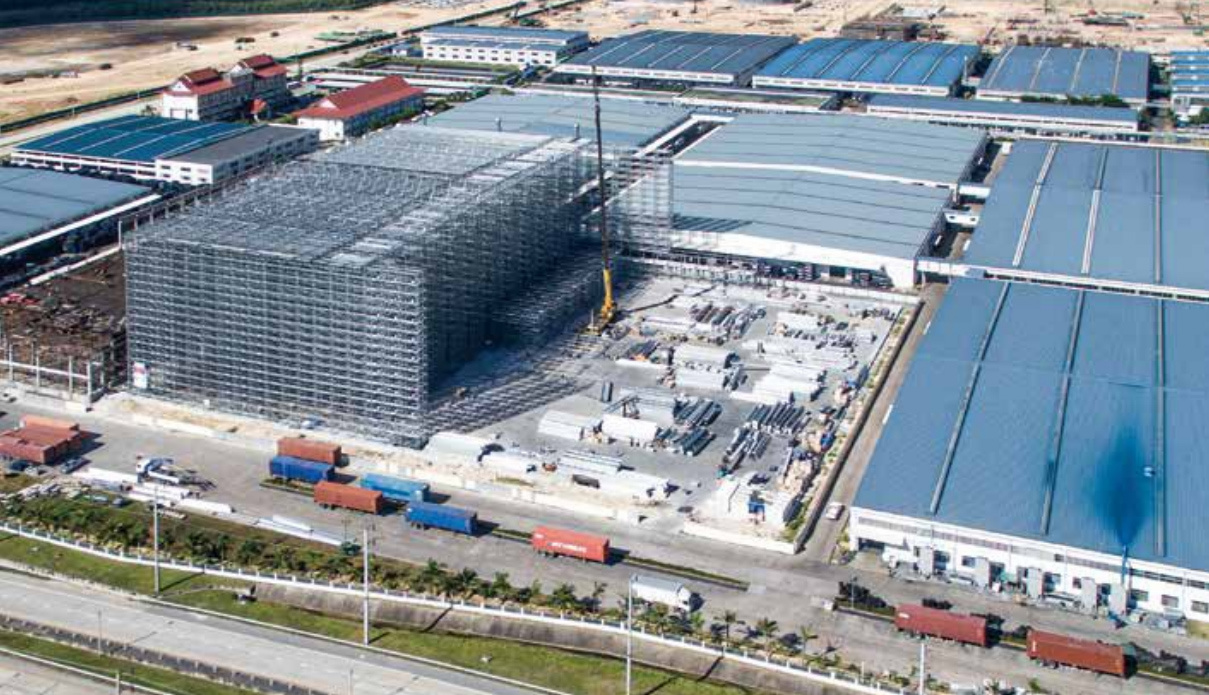
A rack-clad warehouse, as the name suggests, is an integrated structure of warehouse and racking. Its conventional structure consists of internal racks, with exterior walls and a roof built on top of the racks, where the racks serve as the main support structure of the entire warehouse. Specifically, it comprises a structural system consisting of the main rack structure, wind-resistant structures, roof trusses, and enclosure structures, as well as drainage, fire protection, maintenance, and wind-powered refrigeration equipment outside the structural system. GZC has built more than 30 rack-clad warehouses for clients.
Clad-rack warehouse is an integral structure of warehouse and rack. Its conventional design consists of internal racks, wall cladding and roof that is constructed on top of the racks. The racks serve as the main support structure of the entire warehouse. In more detail, it mainly comprises a structural system consisting of rack, wind-resistant structures, roof trusses, and enclosure structures. Furthermore, the facilities for drainage, fire prevention, maintenance, and wind-powered refrigeration, which are external to the structural system, are also included. GZC has built more than 30 Rack-clads for customers.
Advantages
The advantages of rack-clad warehouses are reflected in the following aspects:
Cost Compared to the cost of a conventional warehouse plus racking, the cost difference is not always clear-cut. However, generally speaking, the larger the project, the more obvious the advantages of rack-clad warehouses become.
Construction Time Rack-clad warehouses offer significant advantages in terms of construction time. Traditional warehouses and racking are constructed separately. The warehouse is built first, which takes at least several months. Then, the racking is installed inside the warehouse. Due to space limitations within the warehouse, many large pieces of equipment cannot be used, inevitably affecting the construction progress. Rack installation typically takes several more months. However, with rack-clad warehouses, outdoor construction is not limited by equipment and allows for modular lifting operations with ultra-high cranes. The peripheral structure and racking are constructed simultaneously. Once the racking is installed, the entire warehouse is almost completed. This significantly enhances the project timeline.
Space In terms of space utilization, rack-clad warehouses also offer significant advantages. The internal space of a rack-clad warehouse is almost fully utilized. In contrast, traditional warehouses with separate racking have numerous structural steel columns inside, and the distance between the racking and the warehouse's side and top boundaries is considerable, inevitably limiting space utilization. Rack-clad warehouses allow for higher space utilization, which can be an advantage for special industries, such as cold chain logistics, where space energy efficiency is crucial.

Advantage
| The advantages of the RACK-CLAD are reflected: | is almost completed. This significantly enhances the project timeline. | the area, and the distance between the racks and the warehouse's lateral and vertical boundaries is considerable, inevitably limiting the space utilization. It allows for a higher space utilization, which can be an advantage for special industries, such energy efficiency is crucial. |
||
| In terms of cost, it's not always the case that the higher the cost is better. Generally, the larger the project scale, the more obvious the advantage of rack-clad becomes. | In terms of space utilization, from the utilization of space in the warehouse area, the rack-clad has a greater advantage, the internal space is basically completely utilized, Conversely, in traditional storage facilities, there are numerous structural steel columns within | |||
| In terms of construction, there are significant advantages to rack-clad. The traditional approach of building the warehouse and racks separately, with the warehouse built first, requires a construction period of at least several months. This approach is followed by the construction of the racks, which typically takes several months due to the limitations of warehouse space, making many large-scale equipment unusable, consequently affecting the progress of construction. The outdoor construction of the rack-clad is not constrained by construction equipment, allowing for modular lifting operations with ultra-high cranes. Furthermore, the peripheral structure and the racks are constructed simultaneously. Once the racks are installed, the entire warehouse |  |
|||
①Technical Difficulties of Integrated Warehouse with Storage Rack (Technical difficulties of integrated warehouse with storage rack)

| Rack-clad warehouses are significantly more challenging to design and construct than conventional racking systems.
From a design perspective, in addition to the usual considerations such as earthquakes, it is also necessary to consider local wind, rain, snow, and other external loads, as well as dust accumulation and equipment loads not encountered in conventional racking systems. This means that traditional racking manufacturers must not only be proficient in equipment but also in building construction, steel structure loads, and design. Rack-clad warehouses must not only ensure safety but also ensure that the racking can still meet the operational requirements of automated equipment under these external loads, which places higher demands on racking structural designers. From our company's perspective, we address this through the following three aspects:
Theory Our company is proficient in racking, steel structure, and load codes from China, the US, and Europe, enabling us to solve design problems.
Production We have introduced Germany's most advanced production lines, capable of producing ultra-high-strength and ultra-high-precision main profiles, ensuring product strength and design accuracy. |
Structure Through collaboration with renowned universities and experts in the structural engineering field, and by learning from successful overseas projects, we ensure the rationality of our rack-clad warehouse structures.
From a construction perspective, intertwined construction with other units throughout the project, and the harsh construction environment, with strong sunlight, wind, rain, and snow severely interfering with normal construction. Currently, rack-clad warehouses are generally ultra-high and large-scale projects, facing challenges such as multi-section column connection and the connection of cold-formed thin-walled steel and hot-rolled steel, making it more difficult for racking to meet installation accuracy requirements than conventional projects.
Based on the experience of numerous large-scale projects, we have developed a complete set of key points for on-site construction, setting specific requirements for aspects such as cross-construction management, construction equipment, personnel equipment, large lifting equipment, on-site monitoring, and weather impact, ensuring that the installation of rack-clad warehouses achieves the design objectives. |
Rack-clad poses a significantly greater challenge than traditional racking in terms of design and construction.
First, in terms of design, in addition to typical external factors like earthquakes, consideration must also be given to local wind, rain, snow, and other external loads, as well as dust accumulation and equipment, all of which are not encountered in traditional racks. This means that traditional racking manufacturers must not only be adept at equipment design but also at architecture, steel structure loads, and design. The rack-clad aims not only to ensure safety but also to ensure that the rack can still meet the operational requirements of automated equipment under such external loads, setting higher demands on the rack design personnel. From our own perspective, we approach the problem in three ways as below:
In terms of theory, GZC is proficient in racks, steel structures, and load specifications in China, the United States, and Europe to solve design problems:
In terms of production, the introduction of Germany's most advanced production line allows for the creation of main profiles with high strength and precision, ensuring stability and design accuracy from the product.
In terms of structure, by collaborating with renowned universities and structural experts, and absorbing the experience from successful overseas projects, the rationality of rack-clad is structurally ensured. |
| and snow severely disrupting normal operations. Moreover, rack-clad currently tend to be applied to extremely high or large projects, often facing difficulties during installation, such as multiple sections of upright connection, and matching cold-formed thin-walled steel with hot-rolled steel, making it more challenging to meet the precision requirements for installation than conventional projects.
Through the installation experience of several cases, GZC has summarized a set of key points for on-site construction site construction, and has put forward special requirements for a series of aspects such as cross-construction management, construction equipment, personnel equipment, large sling, on-site monitoring, weather influence, etc., so that the installation of the rack-clad will finally achieve the design goal. |
 |
|||
②Other special requirements for integrated rack-warehouse (Integrated warehouse with storage rack and other special requirements)

| The integrated warehouse with storage rack system is essentially no different from a conventional warehouse + rack system in terms of usage. However, after considering cost, design, and installation difficulty, the integrated warehouse with storage rack system is more suitable for large-scale automated projects, namely large-area, high-rise, high-storage capacity, fully automated unmanned warehousing projects.
The biggest difference between the integrated warehouse with storage rack system and the traditional warehouse + rack system lies in the use of equipment under extreme wind conditions. Due to the influence of wind, the integrated warehouse with storage rack system will "sway with the wind." The degree of sway varies depending on the wind speed. If the sway amplitude is too large, it will affect the operation of internal equipment such as stackers. |
There's no substantial difference in usage when compared to a conventional warehouse + rack system. However,
Compared to traditional warehouses and storage racks, the most significant difference lies in how the equipment is used under extreme wind speed conditions. Due to the influence of wind, rack-clad warehouse can experience wind-induced swaying. The degree of sway varies depending on the wind speed. If the sway amplitude gets too large, it might affect the operation of internal equipment, such as stackers.
Generally, GZC will evaluate the deformation of the rack-clad according to the EN15620, which should be able to satisfy the operations of stackers and other equipment. However, if there are devices within the rack-clad that are highly sensitive to rack-deformation, GZC can conduct a performance-based design for wind resistance according to the deformation requirements proposed by the owner. Consequently, |
higher the requirement for the probability of equipment non-stop under extreme wind speeds, the higher the overall cost. |
③Planning and construction process of integrated rack-warehouse (Planning and construction process of integrated warehouse with storage rack)

More News
Shenzhen Guangzhichao Shelving Industry Development Co., Ltd.
Shenzhen Headquarters: East Zone, Jiuxiangling Industrial Park, Xili Town, Nanshan District, Shenzhen, China
Factory Address: No. 3, Factory Building, No. 12, Fulin Road, Fafangcun Community, Pingdi Sixth Union, Pingdi Street, Longgang District, Shenzhen, Guangdong, China
Factory Address: Pangshangou Guangzhichao Industrial Park, Daying County Industrial Concentrated Development Zone, Suining City, Sichuan Province
Tel:0755-82942082 82942085
Hong Kong Tel:00852-69317568
Fax: 0755-82942080
24-hour service hotline: 13828704327
Official Account

Contact Us


Copyright © 2025 Shenzhen Guangzhichao Shelving Industry Development Co., Ltd.